What is Thai massage?
Traditional Thai massage (in Thai, nuad thai) developed over centuries in Thailand, shaped by Buddhist monastic medicine and influences from India and China. In 2019 UNESCO added it to its list of the Intangible Cultural Heritage of Humanity, a sign of how central it is to Thai culture.
It looks and feels very different from an oil massage:
- You stay clothed, in loose, comfortable clothing.
- No oil is used.
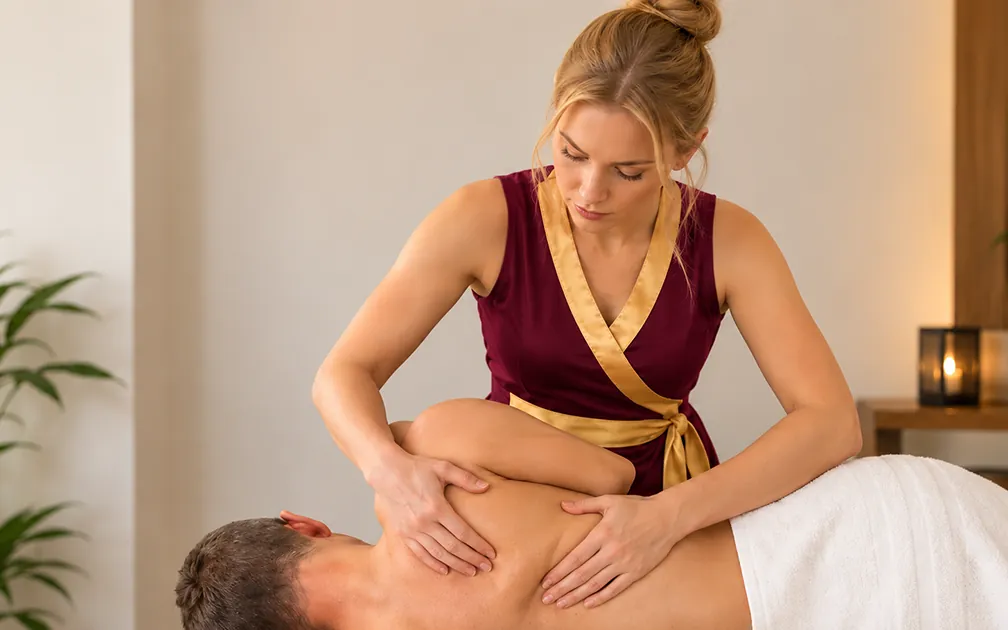
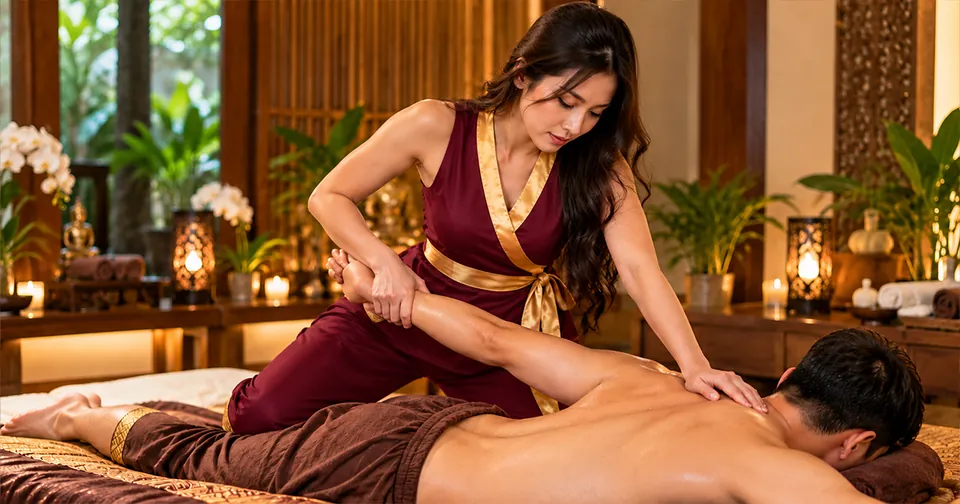
- The therapist uses palms, thumbs, forearms, knees and feet to apply rhythmic pressure along lines of the body.
- Assisted stretches gently move your limbs and back through a comfortable range: twisting, folding and opening.
The traditional theory describes energy lines, called sen, running through the body. That's a cultural framework rather than an anatomical one. The traditional sen-line concept helps explain Thai massage's cultural background, while the treatment itself uses manual pressure and guided movements.
What does it feel like?
A Thai massage has a rhythm of its own: press, release, move, stretch. Your therapist may gently rock you, guide one leg across the body into a twist, or lift your arms to open the chest and shoulders. The pressure is medium to firm, but it comes in waves rather than staying in one spot.
The experience is more movement-focused than a conventional oil massage. Your therapist guides each stretch within a comfortable range, adjusting the position or pressure when needed.
How Thai Massage May Feel After Long Hours of Sitting
Sitting for long periods can leave your hips, back and shoulders feeling stiff. Thai massage uses guided stretches and steady pressure to move these areas gently. The experience may feel like gradually easing out of a cramped position, without the use of massage oil.
The 60 minutes
- Consultation and changing. Tell us about injuries, back or joint problems, and how far you'd like the stretches to go. Change into loose clothing.
- Feet and legs. Traditionally Thai massage starts at the feet: rhythmic pressure up the legs, then hip and leg stretches.
- Back. Palm and thumb pressure either side of the spine, with gentle twists if they suit you.
- Arms, shoulders and neck. Pressure through the arms and gentle stretches that open the chest and shoulders.
- Seated finish. Often a few minutes sitting up for neck, shoulder and back work, and a final stretch.
Is Thai massage right for you?
| Choose Thai massage if… | Consider another option if… |
|---|---|
| You prefer assisted stretching alongside massage pressure. | You want a treatment centred on sustained, localised pressure; consider deep tissue. |
| You prefer to remain clothed during treatment. | You specifically want an oil-based massage; consider Swedish or Moroccan massage. |
| You are comfortable with guided movement and can communicate your limits. | A health condition or recent injury may make stretching unsuitable without professional advice. |
Want strong, hands-on pressure rather than assisted stretching? See Pakistani Massage.
Safety and precautions
Because Thai massage moves your joints, please tell us before your session if you have:
- Back or neck problems, including disc issues or recent spinal surgery
- Hip or knee replacements, or other joint conditions
- Osteoporosis
- High blood pressure or heart conditions
- A recent injury, sprain or surgery
- A history of blood clots, or blood-thinning medication
Tell your therapist about any relevant health conditions, recent surgery, injuries or movement restrictions before the session. Some conditions may require medical advice before massage, and certain stretches may need to be avoided. Stop and tell your therapist immediately if you experience pain, numbness or dizziness.
What Thai massage can and can't do
Research on Thai massage suggests possible short-term benefits for some measures of discomfort and flexibility, but the evidence is limited and results vary. It is not a substitute for medical assessment or treatment, and persistent pain or restricted movement should be assessed by a qualified healthcare professional.
Tips for your first Thai massage
- Wear loose, stretchy clothing, or ask us about what to wear when you book.
- Eat lightly beforehand. Twists and folds are uncomfortable on a full stomach.
- Tell your therapist immediately if a stretch causes pain, dizziness or discomfort.
- Speak up early if a position is uncomfortable.
Myths about Thai massage
- "You need to be flexible." Not at all. Stretches are adapted to your range, and stiff people often enjoy Thai the most.
- "Thai massage is always very hard." It can be firm, but pressure is adjustable like any other treatment.
- "It cracks your back." At Monalisa Spa, Thai massage uses assisted stretches and controlled pressure rather than deliberate high-velocity spinal manipulation. Tell your therapist if any movement feels uncomfortable.
Thai massage in a hot climate
If you are scheduling a session around work or other commitments, allow enough time to finish comfortably before your next activity. You can contact us to check appointment availability for your preferred time.
Thai massage and breathing
Keep your breathing natural throughout the session. If you find yourself holding your breath or bracing against a stretch, ask the therapist to reduce the range of movement or change position.
Book Thai massage in Al Nuaimia
To arrange your Thai massage, send us your preferred appointment time and let us know about any movement limitations you would like the therapist to consider. We will confirm your booking before you travel.
Last updated: